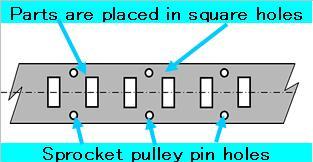
Parts are directly set on square holes in a belt.
Monday, September 17, 2012
On Steel Belt No.16 Positioning and takt drive by perforated belts
The second most popular perforation type is as below,
Parts are directly set on square holes in a belt.
Labels:
accurate conveying,
Positioning,
precise conveying,
takt drive
Tuesday, September 11, 2012
On Steel Belt No.15 Positioning and takt drive by perforated belts
We'd like to show some of very popular perforation on belts.
By adding perforation belts can do additional jobs.
The first one is as below.
Jigs are fixed on every pair of holes on a belt.
Those jigs accept parts and these parts receive a certain process, assembly or inspection. This whole conveyance is done by takt drive, using sprocket pulley pin holes.
By adding perforation belts can do additional jobs.
The first one is as below.
Jigs are fixed on every pair of holes on a belt.
Those jigs accept parts and these parts receive a certain process, assembly or inspection. This whole conveyance is done by takt drive, using sprocket pulley pin holes.
Friday, September 7, 2012
Steel Belt Dymco won Yokohama Chizai Mirai Enterprise Award
The city gov't of Yokohama granted Yokohama Chizai Mirai Enterprise Award to 37 small and medium-seized companies in Yokohama out of more than 100,000 companies in this area. Steel Belt Dymco won this award. The picture below is the certificate. Management based on Innovative products and service and their intellectual properties are evaluated.
(Japaese page)
Friday, August 17, 2012
On Steel Belt No.14 Welded Endless Belt #4
Above is a figure of stress (S) against the number of cycles to failure (N).
This curve begins to get flat at over one million bendings and becomes flat at over ten million bendings.Pulley diameter = Belt thickness x 700
Coefficient 700 is set to make the same stress as the one in the chart above so that the belt endures 10 million bendings.
When bendings are not so many,
700 can be 600 or 500
This is to be discussed and adjusted when we decide belt specifications.
http://www.steelbelt.jp/product/stainlesssteelbelt/d_type_dymco_welded_endless_steel_belt.php
Tuesday, August 14, 2012
On Steel Belt No.13 Welded Endless Belt #3
Below is shown relationship between tensile load and elongation.
Steel belts are made by tensile stainless steel.
Tensile metals are stronger than Copper and Low-carbon steel.
But welded area is weak due to heat during welding.
http://www.steelbelt.jp/product/stainlesssteelbelt/productra.php
Steel belts are made by tensile stainless steel.
Tensile metals are stronger than Copper and Low-carbon steel.
But welded area is weak due to heat during welding.
http://www.steelbelt.jp/product/stainlesssteelbelt/productra.php
Sunday, August 12, 2012
On Steel Belt No.12 Welded Endless Belt #2
http://www.steelbelt.jp/product/stainlesssteelbelt/d_type_dymco_welded_endless_steel_belt.php
When we try steel belts, we set pulley diameter first.
Pulley diameter = Belt thickness x 700
For instance,
when belt thickness is 0.1mm,
When we try steel belts, we set pulley diameter first.
Pulley diameter = Belt thickness x 700
For instance,
when belt thickness is 0.1mm,
pulley diameter is 70mm.
This is a norm.
Depending on applications,
It may be x 800, or x600, or x400.
The picture below, in our standard conveyor,
Pulley diameter 50mm=Belt thickness 0.15mm x about 350.
Labels:
belt thickness,
pulley diameter,
welded steel belt
Tuesday, August 7, 2012
On Steel Belt No.11 Welded Endless Belt #1
DYMCO employs plasma welding mainly,
which is appropriate for thin stainless steel,
rather than TIG and laser welding.
The picture below is cross section of the welded area in a 0.3mm-thick belt. Half-round stripe areas are melted by welding heat, while Diamond-shaped black points are positions where hardness was checked. In this way we know hardness and other characteristics in steel grades and welding conditions.
which is appropriate for thin stainless steel,
rather than TIG and laser welding.
The picture below is cross section of the welded area in a 0.3mm-thick belt. Half-round stripe areas are melted by welding heat, while Diamond-shaped black points are positions where hardness was checked. In this way we know hardness and other characteristics in steel grades and welding conditions.
Labels:
plasma welding,
steel belt,
TIG welding,
welded belts
Subscribe to:
Posts (Atom)
